

2022: 52 out of 4,000 weeks
We have limited time in our lives. Where you focus your attention will be your life. In addition, you can achieve more than you think you can in the long term. What will you achieve in 2022? What did you achieve in 2021?
I’m listening to a book titled “Four Thousand Weeks: Time Management for Mortals” by Oliver Burkeman.* The premise is that we only live on average 4,000 weeks. Where ones spends her time and where she puts her attention is her life. It’s not something else; it’s not what we wish it were. What we do in these 4,000 weeks is our life.
*For an excellent summary of “Four Thousand Weeks”, read this blog post by The Marginalian.
Another 52 weeks is coming to a close. What did you accomplish? If you really think about this, my guess is you’ll find you did more and accomplished more than you realize. You may also find that you set a goal back in March that’s still unachieved. (I recently realized this about myself when I was looking back through my journals for the year and realized that some of my goals are unmet all these months later. I’m in the process of reevaluating those goals to see which ones will enter 2022 with me.)
As a famous saying goes, we overestimate what we can achieve in a year and underestimate what we can achieve in ten years. Looking at this from a shorter time frame, we overestimate what we can do in a week but underestimate what we can do in year. Time moves on whether we work toward our goals or not.
In Dorie Clark’s new book, The Long Game: How to be a Long-Term Thinker in a Short-Term World, she helps the reader move toward their longer term goals. In an interview with Forbes, she states: “Strategic patience recognizes that things often do take a while – in fact, often much longer than we want them to. That being said, we can work toward them assiduously, track our progress, and adjust if it seems like things aren’t developing the way we want (or if another, better option presents itself). It’s being patient so we can pursue long-term goals that are substantial and meaningful, but still steering our own destiny.”
If you need some help identifying your priorities, consider mind mapping. I find it to be a creative way to think about and organize ideas. As I mind map, I see connections between related ideas. As I see more connections to a given idea, I find that idea is a higher priority for me.
I leave you with these questions: What will you achieve in 2022? What are your priorities for 2022?

Forests and Teams: What do they share?
Forests operate as a single organism, sharing information and nutrients, which increases the forest’s resilience. What can your team learn from the forest?

Why should you take your coaching conversations into nature? Why would you offer nature-based leadership coaching to your teams?
With Nature-Based Leadership Coaching, the coaching conversation takes place in nature. Either the client is in nature and the coach is not, the coach and client are both in nature together, or the coach and client are in nature in different places talking on the phone. A client might go into nature to reflect and then have a coaching call around that experience afterward.
Nature is part of the coaching process. It allows your team members to experience coaching in a new way, away from a screen, outside of the four walls. Away from colleagues. And in a place where our brains can be free from the constant to do list.
We put our assumptions on nature — how it works, what it is, what it means. An example is that some assume nature is about kill or be killed, organisms fighting for finite resources. What we are learning though is that isn’t really what’s happening. We need to look deeper to see what is really going on. I’ve thought of trees as ‘fighting’ for the sunlight; trying to beat each other out of limited nutrients. I found Fantastic Fungi, a documentary about the amazing underground communication between fungi and trees, to be helpful in my understanding of what is really going on underneath the surface in the forest.
What we are starting to understand is that trees share nutrients, they communicate with one another, they thrive off one another, and the forest operates as a single organism. There is symbiosis that we humans can’t see unless we zoom in and study it. Suzanne Simard’s TED Talk explains this. She notes that the more diverse the forest, the more resilient it is. And when information and nutrients are shared between organisms, the more resilient the forest becomes.
Can you look at your team as nourishing you? Could you see your team working together because together you succeed rather than competing for limited resources? By looking at nature in a new light, your team may be able to see themselves and their teammates in a new light, perhaps as a single organism working to build its own resilience.

Build Trusting Teams
Build Trusting Teams, a Simon Sinek, Inc. event.
Choice nuggets include:
You can’t make anyone trust you. You can only behave in a way that allows people to choose to trust you.
Trust is a feeling we get. And it’s an active choice that we have to make.
All we can do is show up in a way that encourages people to trust us.
A week or so ago, I attended a webinar, Build Trusting Teams, a Simon Sinek, Inc. event. (There are more of these coming up.)
Here are some choice nuggets:
It is hard to build trust when waters are rough. It’s better to do it when waters are calm so that when we need it, we have it.
You can’t make anyone trust you. You can only behave in a way that allows people to choose to trust you.
Trust is a feeling we get. And it’s an active choice that we have to make.
All we can do is show up in a way that encourages people to trust us.
Trust needs to be built, maintained and repaired. To repair it, must show consistency to desire to repair it. If you know you’ve broken trust, humility and willingness to say that you know you broke trust and here’s how I did it (if you know) and you want to fix it.
Feedback
Get in the habit of having feedback conversations. Then people don’t fear it as much.
How to deliver and accept feedback. FBI. Feeling. Behavior. Impact. (This is similar to SBI: situation, behavior, impact that I learned about in my sustainability masters program.) What is the feeling, specific behavior, impact of the behavior.
Ask better questions
Monitor the types of questions we are asking ourselves. Because our brains will come up with an answer. So are we asking the right questions. Ask more empowering questions. Ask more generative or building questions. “how can I improve ….” What ways can I implement new habits to get better at ….”
The quality of our lives is correlated to the quality of questions we ask ourselves.
Culture
Live the culture. Culture = values + behavior
Strength of culture is the degree to which values are lived. Articulate values as verbs or action phrases.
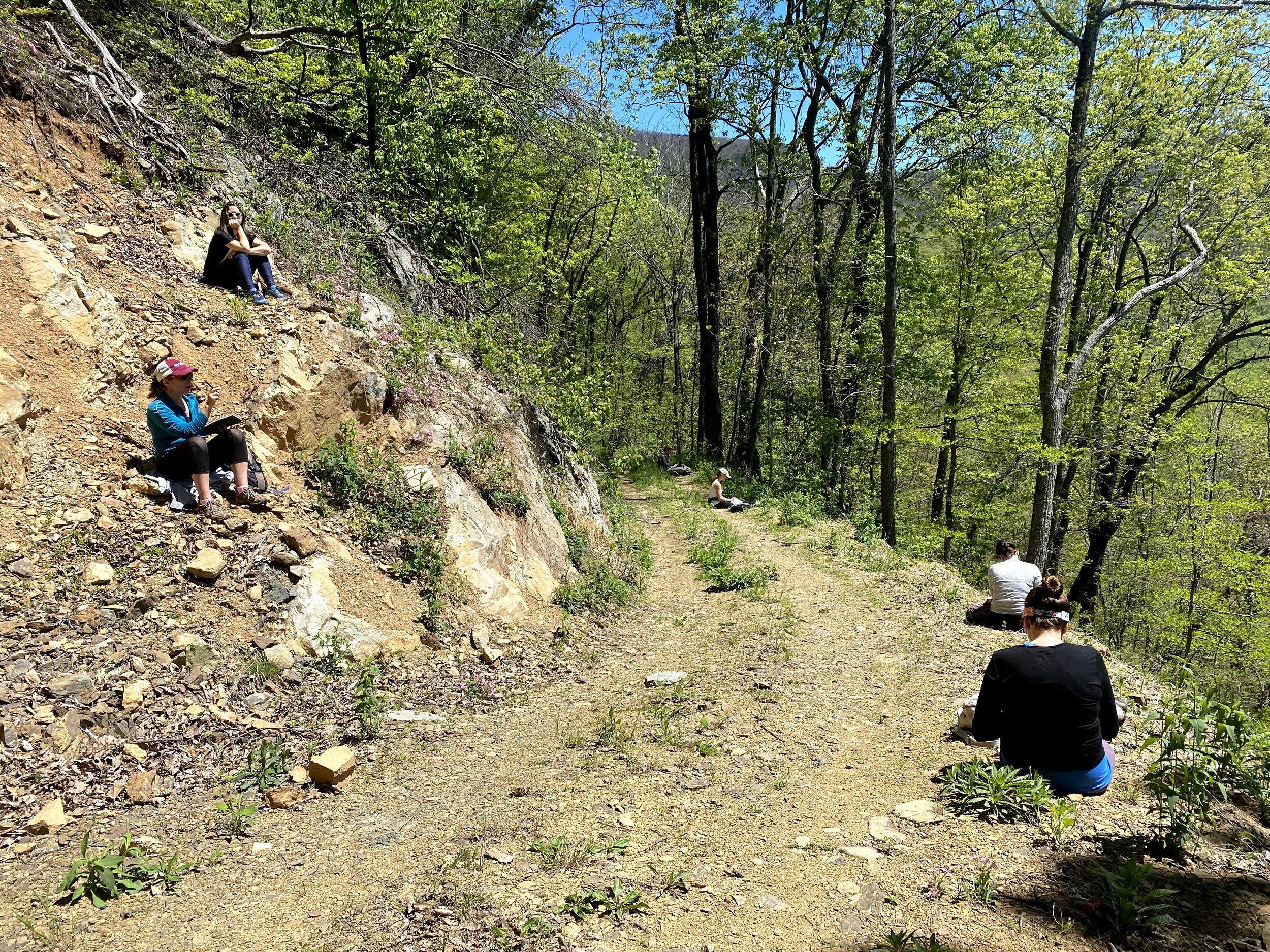
Wellness Retreat in the Mountains
With everyone fully vaccinated, we headed to the mountains for a much-needed wellness retreat. We expressed gratitude, moved through Qoya with our amazing instructor Laura Farmer, and I led the group through Nature Roaming™.

With everyone fully vaccinated, we headed to the mountains for a much-needed wellness retreat. We expressed gratitude, moved through Qoya with our amazing instructor Laura Farmer, and I led the group through Nature Roaming™.

Getting ready to Nature Roam™! I’m explaining the three parts (Roam (silently, with intention in mind), Connect (journaling on what you saw—connecting the dots; and connecting with each other through sharing), Grow (what to do after this event; how to continue learning).

Did I mention that it’s spring in Virginia! The flowers are in bloom!

Lots of journaling and reflecting happening along the trail

Canadian Wood Betony

We captured the moment after a glorious hike and reflection. (And one of us spotted a black bear!)

Environmental lawyers give tips on career transitions
Tips from leading environmental lawyers about making a career transition
There is something you might find more difficult than the legal problems you face every day: deciding when and whether to make a career change. The breadth of experience within the Section of Environment, Energy, and Resources is astounding, and no matter where you are in your career, there are others who’ve been in your shoes and have made successful transitions. These are their tips.
Types of career transitions
There are two main types of career transitions that environmental, energy, and natural resources lawyers make: (1) changing sectors—e.g., private firm to government and (2) moving from law to non-law, e.g., consultancy, policy, academia. This article mainly consists of tips from lawyers who have practiced law in different sectors.
Twenty tips from Section lawyers
There are some themes in these tips, which are in the lawyers’ own words: your network is critically important, be kind to yourself and also push yourself, things may turn out differently than you expected, and take the time to understand the culture of your new organization.
Susan Floyd, senior counsel with a utility company:
The skills and abilities you acquired in your previous position have led you to this new position. Consequently, continue to hone and develop those skills and abilities so you do not lose any “muscle memory” in those areas.
You will start the new position excited and ready to get things done and prove that you were the “right” hire—so stop, breathe, and take the time to get to know the culture of the entity where you now work and to understand the communication preferences of those that you are working with in your new position.
Be kind to yourself—remind yourself of how you have grown, what you have learned and why you wake up every day and do what you do. Reflect on your strengths while being open to where and how you can continue to grow and learn. Take every opportunity to push yourself at crossroads. By continually reflecting and reminding yourself of what is important to you, you will avoid doing things without thought and direction.
Juge Gregg, law firm; government (DOJ); in-house at a large tech firm:
Don’t pick a destination; pick a next step. Think about your next step and what gets you most excited about it. Don’t take a job you don’t want to do because you think it will get you where you want to be.
Keep your eyes open. Maybe you are not “ready” to move, but keep your eyes open for opportunities.
Build and maintain your network. Stay in touch with colleagues. Former colleagues and Section colleagues can help you with your career moves, preparing for interviews, etc.
Stacey Halliday, law firm and government (EPA) experience; military spouse working overseas:
Map out scenarios for your transition, with an ideal outcome and a few alternatives that incorporate your upper and lower limits (including salary, benefits, etc.).
Identify dedicated sponsors to inform your options and invest in supporting your transition—be as transparent as possible with these sponsors to ensure that they are fully informed of the dynamics at play.
Don’t be afraid to take a little (informed) risk to challenge yourself, build resilience, spark progress, develop new professional muscles, and—in the best cases—surprise yourself.
Brenda Mallory, law firm; government; NGO:
It rarely works out exactly the way you imagined. Sometimes that’s good; sometimes, not so much. It’s helpful to recognize this going in; you’ll spend less time focused on your disappointment. You have to go into each new situation prepared to make the best of whatever it offers.
When transitioning for the first time from private firm to government or NGO, don’t underestimate the cultural differences between those various communities. The culture affects how you interact, get things done, the career path, and opportunities, just to name a few. You should try to explore those differences as part of considering options but recognize that many things won’t be obvious until you’re on board. Be prepared to adjust.
The personal strengths and qualities that got you to where you are will get you through the transition. Personal resilience is key to whatever you do. You work on building it early and then tap into it during whatever life challenges you face. Navigating your way through transitions is no different. You just have to remember to go back to whatever are the “basics” for you.
Roger Martella, government (DOJ and EPA); law firm; in-house counsel:
Surround yourself with people who can give you advice and who have your back. Your network is important for finding opportunities, seeking advice, and helping you prepare for a new role.
While it’s important to have a network to reach out to for support and advice, ultimately, you should trust your own judgment and listen to your inner voice on what’s the best decision for you based on your personal goals. You’ll always be most successful when you’re doing something that you’re passionate about personally.
Jonathan Nwagbaraocha, internal transition at a large workplace technology company to EHSS counsel:
Relationships matter: Get to know the team you are counseling because this is important when trying to establish an open and candid line of communication. The team you want to counsel needs to know the type of person you are, and it is equally important for you to understand the processes, policies, and decisions that the team is dealing with.
Give yourself a break: Any job transition requires you to recharge/recalibrate/refresh. Find the opportunity to have a week or more break before you start a new position.
Lauran Sturm, large law firm; state environmental department:
Be prepared for the financial impacts of moving to government. You’re probably already aware of the discrepancies in salary, bonus structure, and pension/401K arrangement, but there are other perks that you may be accustomed to in firm life that you’re less likely to find in government.
Be aware of potential time-management changes. Depending on your level in the firm, you may be spending a lot of time on business development activities in the evenings. While your schedule should free up in that regard when you move to government, you may find that your days quickly fill up with various committee or client meetings, meaning less desk-time. It may take some time to learn how to balance the meeting expectations with your actual day-to-day work.
Jennifer Wills, EPA lawyer to professional coach:
If possible, try the other career as a side hustle for a little bit. You may learn some ways to become more successful when you finally make the switch. You may find that you don’t want to make the switch after all!
Undertake formal training if the transition is significant—not necessarily a master’s degree; there could be a certificate or online course or two to learn more about the new job/career and build your credentials.
©2020. Published in Trends, Vol. 52, No. 1, Sept/Oct 2020, by the American Bar Association. Reproduced with permission. All rights reserved. This information or any portion thereof may not be copied or disseminated in any form or by any means or stored in an electronic database or retrieval system without the express written consent of the American Bar Association or the copyright holder.

Are you ready for a career pivot?
Career change. Career transition. Career pivot. Call it what you like; many of us are making changes in our careers—voluntarily or otherwise.
In this post, I share three books related to career changing and finding what’s right for you. Each book takes a slightly different approach, but there are some common themes among them, along with creative activities.
Career change. Career transition. Career pivot. Call it what you like; many of us are making changes in our careers—voluntarily or otherwise. And if you’re not making changes now, you should be thinking about what your next move could be, or developing skills to stay relevant in today’s changing workplace.
In this post, I share three books related to career changing and finding what’s right for you. Each book takes a slightly different approach, but there are some common themes among them, along with creative activities.
Pivot: The Only Move That Matters Is Your Next One, by Jenny Blake
Designing Your Life, by Bill Burnett and Dave Evans (also authors of Designing Your Work Life, which is on my reading list)
Reinventing You, by Dorie Clark
The idea of reinventing oneself isn’t how I think about making a career transition. We are who we are; we have strengths and experiences, and we can build on those. We can further develop our skills and build upon our foundation, but we are the person we are. As Jenny Blake suggests in Pivot: The Only Move That Matters Is Your Next One, pivoting is like basketball, where one foot remains in position while the rest of your body turns. You remain at the center.
Many of my clients come to me from a place of discontent with their current careers and a readiness to move forward with something more meaningful, particularly in the sustainability space. Sustainability is broad and varied, so it can feel overwhelming. Although considering a career transition may be outside your comfort zone, you may feel more resolute if you think deeply about why you want to make an impact in the world. What is guiding you? The answers might include your values and a purpose statement. You can reflect on these and feel more grounded as you enter the exploratory phase of your career transition.
As you read these books, keep these points in mind:
Start with who you are and where you are: Each book has its own approach to this. For instance, Designing Your Lifeincludes “Good Time” Journaling (journal about what you enjoy doing) and Reinventing You suggests you discover how others perceive you by conducting personal 360 interviews. Finally, Pivot walks through exercises, such as mind mapping, to identify your values, principles, and strengths.
Learn about what’s possible and identify whether it’s right for you: Networking and interviewing individuals can help you discover what a career is really like. Every book stresses the importance of talking with others about their careers. Networking cannot be overstated for career development in general. CLiGS blog posts also stress it here and here, and alumni of the program discuss the importance of networking in their careers, for example Molly Brown’s story here.
Try out some possibilities without fully committing to the change: Each book has its own term for trying out a career path before making a change: “prototype experiences” (Designing Your Life), “test-drive” (Reinventing You), “pilot” (Pivot). Each suggests apprenticing, volunteering, and shadowing as ways to do this.
Designing Your Life asserts that there are multiple great lives we could each live, and you get to choose which one to live next. This means there can be more than one great career for each of us. I love this idea, and have lived it myself. I had been an attorney with the U.S. Environmental Protection Agency for over a decade. I didn’t want to work for the government anymore, and I didn’t want to be an attorney anymore. So, about twelve years ago, I decided I wanted to start a small organic farm. I took a course on starting a farm business. I apprenticed on a farm. I volunteered for small farm member-based organizations. What I learned is that living on a farm is a family endeavor, and not having the entire family on board meant that I needed to consider a different pivot, a different “great life.”
The Center for Leadership in Global Sustainability and the Executive Master of Natural Resources (XMNR) program helped me with the pivot I ultimately made. At the time I was going through the program (2016), I wanted to work for a corporation that was doing good sustainability work. I got an interview with a very prominent company, but the location was not where I wanted to move my family. So, I went back to the drawing board to figure out what I could do from my small town in central Virginia. I hired a career coach. I took a class on entrepreneurship. I developed a process for working through career transitions. While working part-time with the EPA, I started my coaching business and started working with clients who were seeking personal and professional growth, including career transitions. Now I coach XMNR students seeking career transitions, self discovery, and professional development. I continue to hone my coaching skills. I completed a 140+ hour International Coach Federation accredited course through George Mason University. I am now working toward ICF certification, and I’ve developed a method for coaching individuals outdoors that provides a unique approach to coaching and the coaching experience.
I hope that you find one or more of these books helpful in working through your career transition. I’m happy to talk with you about personal and professional growth, and preparing for and embracing change. You can find me at www.jwillscoaching.com.
*Originally published at https://cligs.vt.edu/blog/are-you-ready-for-a-career-pivot-.html
5 Simple Tips for Holiday Networking
I’ve heard some version of this story many times: Someone I know from my tennis/sewing/mountaineering club told me about a job at company X, and it’s perfect for me. She connected me with the hiring manager, who reviewed my application. I got the job!
Whether you are someone who loves networking or someone who loathes it, the reality is that networking is essential for your career. You need it for moving a program forward in your current role, or for moving your career forward into another role.
This time of year offers plenty of opportunities for making connections that are easy to overlook. Traveling to visit family? Networking can happen on a plane! Deciding among too many holiday party invitations? Accept them all! Any and all of these social gatherings can be excellent networking opportunities, if you approach them in the right frame of mind.
Basic tips for expanding your network while enjoying canapes:
1. Find jobs through people, not postings By some estimates, up to 80 percent of jobs are not posted on job websites. This is why your network is so important.
That doesn’t mean job sites should be ignored, however. You can use them to get a sense of keywords for your resume and LinkedIn profile; you can improve your understanding of the qualifications typically sought for certain roles; and you can identify hiring trends in different sectors.
2. Don’t overwork the networking It wasn’t the mountaineering club acquaintance who worked at company X; she knew someone there. And it wasn’t the career-seeker’s acquaintance who was a member of the local sustainability association; she shared a common hobby with someone who was.
It seems rather random, and you may be wondering how you can strategically build your network when you don’t know where you’ll meet an acquaintance with connections in your career field. They could be anywhere! In this case, do what you love and see who you meet.
To build your network, joining associations or local organizations that relate to your field, or a field you’re interested in, is a good place to start. Simply reaching out to individuals for coffee is also an option. When you do that, keep in mind that networking is give-and-take. Offer a relevant article or piece of information when you reach out to someone. Maybe you’ve read an article they wrote and you have thoughts about it you want to share, or maybe you are in a similar industry and you have insights to offer.
3. Think beyond formal networking formats Consider all those holiday parties and whom you might meet there. Perhaps it’s someone you haven’t seen in a few years, or someone you’ve never met before. You’ve probably heard of Mark Granovetter’s paper titled The Strength of Weak Ties (American Journal of Sociology, Vol.78, No.6 (May, 1973)). The idea is that you are more likely to get information from weak ties in your network than from close ties. This is because the people with close ties to you have similar networks as you and similar information. Hence, the need to broaden your network to learn about new positions and trends in your industry or other industries. For additional information on this concept, read Why Every Employee Should Be Building Weak Ties at Work.
In the Executive Master of Natural Resources (XMNR)program at the Virginia Tech Center for Leadership in Global Sustainability (CLiGS), students build their network in several ways. They create a “network map” to evaluate their network. They learn about informational interviewing and add to their network in that way. I
4. Advocate for yourself CLiGS’ current Program Coordinator wasn’t initially hired when she applied for the position. She was still interested in CLiGS, though, and when she saw that the International Society of Sustainability Professionals (ISSP) and CLiGS were co-hosting a happy hour in Washington, D.C., she mentioned her interest in working for CLiGS in her RSVP email. I sent that email to the faculty in the program who have hiring authority. As CLiGS faculty are a close-knit group, her name was already familiar to the head of the program when she met with them a few days after the happy hour. Coincidentally, the first person hired for the job left the Center shortly after that happy hour, so the position was open again. She kept the connection and she got the job.
5. Show up and listen Listening is a vital component to networking and relationship building. There are many articles about the different levels of listening, which range from distinguishing 3 levels to 8 levels depending on the source. I recently learned about Levels 1, 2 and 3 listening in a book called Co-Active Coaching: Changing Business, Transforming Lives. Level 1 listening is when the focus is on yourself, on how the words the other person is saying relate to you. Level 1 listening has a role, especially when getting to know someone. For example, you want to find things in common, or you listen for something the other person says that relates to you and then you share a story about yourself. Level 2 listening gets deeper: you are hearing what the other person is saying without thinking about your next question or statement. Level 3 listening is a deeper level of listening where the listener uses all of his or her senses. To build relationships, you need more Level 2 and 3 listening.
Networking is important to your career. Think of it as relationship building, if that helps. Remember that when networking, you should do what works for you. If one-on-one is better for you, reach out for coffee or a meeting. If you like groups, go to an association networking event or conference. Do both! Then let people know what you’re interested in doing as a next career move, and be sure to listen—really listen—to the other person. You may walk away with a whole new appreciation for the person and for the idea of networking.
Seven “soft skills” to stay professionally relevant
According to a jobs report by the World Economic Forum, the future of the workforce will require interpersonal and leadership skills (e.g., empathy, collaboration), and this is as true for global sustainability professionals as it is for other careers. The report emphasizes that “‘Human’ skills such as creativity, originality and initiative, critical thinking, persuasion, and negotiation will likewise retain or increase their value, as will attention to detail, resilience, flexibility and complex problem-solving. Emotional intelligence, leadership and social influence, as well as service orientation, also see an outsized increase in demand relative to their current prominence.”
These “soft skills” will help any professional and especially sustainability professionals to be successful in their careers, now and in the future. Students in the Virginia Tech Center for Leadership in Global Sustainability Executive Master of Natural Resources program hone their soft skills in a variety of ways—building and maintaining effective teams; resolving conflicts to mutual benefit; learning techniques for cross-sector negotiations; applying social theory insights to sustainability challenges, and more.
A Harvard Business Review article titled “7 Skills That Aren’t About to Be Automated,” describes seven “soft skills” employees should have to be competitive in the future. While the article is about skills that cannot be automated in the foreseeable future, these are very relevant skills to sustainability professionals. We review each of these soft skills below, as it applies to our field:
Communication, particularly storytelling and persuasive communication Communication is the bedrock skill for sustainability professionals. You will need to communicate with a wide variety of stakeholders, some who understand sustainability and some who don’t. Sustainability professionals must be able to persuade others of the importance of sustainability or of taking certain action or changing behavior. While not mentioned in the HBR article, this EHS careers article mentions the importance of public speaking and persuasion. Public speaking is another skill sustainability professionals could use to persuade.
Content or expertise about a given topic and communicating your understanding of the topic Although not a soft skill, sustainability professionals should have at least one area of expertise, whether that’s “sustainability” itself or a specific aspect of sustainability such as circular economy, life-cycle analysis, reporting, or some other area expertise.
Context and the ability to modify your presentation based on your audience It almost goes without saying that this is critically important to sustainability job seekers. Employers will want to know that you have the context necessary to effectively present your position throughout the enterprise and outside it as well.
Emotional competence Understanding the emotions of your colleagues and stakeholders about a given situation can be useful when presenting your case for forward movement. Storytelling is very important in evoking emotions to lead to your preferred action.
Teaching Understanding the skills and knowledge gaps of people in your organization and how those individuals relate to the needs of the organization will give you, as manager, the ability to focus teaching on those gaps. As a sustainability professional, you will be teaching throughout your organization and across organizations about what sustainability is, why it’s important and how to move in the direction of sustainable development.
Networks Being able to access a vast network of people is important when moving into a new position or seeking new employment. Most jobs come from your extended network rather than from job postings. We discuss approaches to networking during career coaching sessions, available to all our students.
Strong moral values While the article explains that Artificial Intelligence (AI) and robots are incapable of moral judgment, having strong moral values and ethics is essential for us as humans. For the sustainability professional, it is important because there will be many times in your career when you must make a judgment and having those values to fall back on will help you make the call. As a job seeker, being able to articulate those values will help you show a future employer your trustworthiness, integrity, and professionalism.
Another set of soft skills that we contend is important for sustainability leaders now and in the future, and ones that will further protect them from automation involves cross-cultural competencies and a global mindset. Sustainability professionals must understand the challenges and opportunities of multinational corporations as well as develop that part of one’s leadership repertoire related to diversity and cultural appreciation. That’s why all our students have an opportunity to collaborate with sustainability organizations around the world during the Global Study program modules.
To summarize, employers seek well-rounded, generalists as well as specialists. Employees should have strong interpersonal and leadership skills. Whether you are on the hiring or job-seeking side of this equation, it’s crucial to understanding the significance of these soft and—very human—skills for the future of work.
Sustainability books for your career search
As a coach specializing in the sustainability field, I often talk to people who are looking for advice on find a meaningful career where they can make a difference for the future of our planet. Many of these conversations are with the graduate students at the Virginia Tech Center for Leadership in Global Sustainability (CLiGS), where I consult, and where I earned my Executive Master’s and developed a deeper understanding of sustainability issues and careers.
There are lots of books related to green careers and sustainability—how to get a job in a sustainability field, applying sustainability principles to business, etc. And there are books dedicated to a particular sustainability subject (e.g., plastics, climate, food). This post is about career books. Below are recommendations of four books, with summaries to help you decide which one you want to read first.
Profession and Purpose: A resource guide for MBA careers in sustainability, by Katie Kross (2009; 2017 update)
Profession and Purpose, while geared toward MBA students and graduates, can be useful to non-MBAs as well. It includes information and tips on different career paths in fields such as corporate social responsibility, consulting, energy, real estate, NGOs, and investing. For each of these fields, Ms. Kross includes keywords that you can use in your job searches, a list of potential employers, skills needed, examples of actual roles at specific companies, and key resources. She then explains what the career paths might entail and includes tips on how to go about the job search. For each career path she includes a profile of an MBA alum who has acquired a job in that particular career, or multiple profiles. An entire section of the book is focused on job search resources, including advice on how to identify sustainable companies, news and blog websites, job posting websites, books, and events.
The book includes two frameworks to narrow your job search:
1. By functional discipline: Whether you are interested in strategy, finance and accounting, marketing, operations, supply chain, or general management, this book includes a chart outlining disciplines and the potential sustainability careers within each. It also includes a table of actual positions at organizations in each discipline, which can serve as a helpful guide to navigating organizational structures.
2) By organization and role: Once you identify the functional discipline(s) that interest you the most, think about the role and type of organization where you’d apply those skills. Ms. Kross provides a useful matrix with four quadrants: traditional roles in traditional companies/organizations; sustainability roles in traditional companies/organizations; traditional roles in sustainability-focused companies/organizations; and sustainability roles in sustainability-focused companies/organizations.
Tailoring the Green Suit: Empowering yourself for an executive career in the new green economy, by Dan Smolen (2011)
Even if you’re not at the executive level, it offers information you may find useful, such as the history of the green economy and how to incorporate environmentally preferable practices in your personal life.
As with other sustainability careers books, Tailoring the Green Suit starts by defining what a green job is. For the purposes of this book, it is a job at a company that has a positive impact on the triple bottom line, that has good corporate governance practices, and that encourages green business training and education, among other qualities. The author breaks these jobs into “obvious green business executive jobs” (those with direct impact on the environment or a company’s environmental policy, such as sustainability officers, environmental engineers, environmental attorneys, climatologists, renewable energy managers, environmental scientists, or urban planners, to name a few) and “not-so-obvious green business executive jobs” (jobs at companies that at first glance may not seem to be green, but that have sustainability practices in place that positively impact the triple bottom line).
Mr. Smolen sets out steps for moving into a new career, including getting an advanced degree, updating your resume, and working with an executive recruiter. He also touches on personal branding and expertise, including speaking and writing about green business topics, mentoring others, and taking steps in your personal life to be more green. He provides ideas for executives to establish their green cred within their current businesses, such as by developing sustainability programs and encouraging environmentally-friendly commuting options. The book finishes with a chapter on starting your own green business with a handful of suggestions to get you thinking.
Sustainability at Work: Careers that make a difference, by Marilyn Waite (2017)
This book provides in-depth information on important aspects of sustainability and sustainable development. It also helps those who want to know how they can incorporate sustainability considerations into their current (or future) role. Ms. Waite’s book is organized by sector (e.g., health care, law, economics, education). She describes each sector, the different roles within each sector, and how to incorporate sustainability considerations into those roles. Ms. Waite evaluates careers in each sector using her SURF framework: considerations related to supply chain, users, internal and external relationships, and future generations.
Ms. Waite clearly has done significant research. She has traveled to distant parts of the globe to meet with and interview people in sustainability careers, whose stories she includes in the book. She shows her research at the end of each chapter with a thorough list of resources and references. She also includes practical tips for professionals in each sector, including reference guides to be familiar with, professional networks to join, conferences to attend, and publications to read and contribute to. She also educates the reader on sustainability terminology, frameworks, standards, and guidelines.
Sustainability Jobs: The complete guide to landing your dream job, by Kevin Wilhelm (2016)
This is a very practical how-to-get-a-career-in-sustainability book. It has six sections, some with accompanying worksheets.
Who are you and what you want. This chapter covers your inventory of needs and wants, your networks, and identifying your next step. It helps you think through ways of getting experience, in your current position or through volunteering, that will make you more competitive in the job market.
Exploring your options. This covers how to create your own position and how to make the business case for sustainability. Mr. Whilhelm’s approach is to inventory your skills and then layer sustainability on top of that. For instance, if you are in finance: What relevant skills do you have? Then, consider how to bring your expertise to the sustainability realm. Businesses need finance, legal, marketing, etc. specialists, and if you understand sustainability you can differentiate yourself.
Target your job search. Narrow the job search by eliminating possibilities and really focusing your search. This section also covers setting a schedule and timeline for your search. It includes developing a list of companies and positions that are right for you, by creating keywords for job searching, finding companies that interest you and following them, and finding contacts at those companies. Finally, it advises figuring out what skills you may lack and developing a plan to get them.
Tailor your resume. This section provides tips, and examples of a good resume, a bad resume, and a bad cover letter. Some tips worth mentioning: List only up to six skills, and make sure those are your best ones. Put relevant experience at the top, even if it’s not the most recent. The top third of your resume is most important. Three or four bullets for each position on your resume is enough.
Execution. Networking is how to get it done. This section is the longest of the book, which makes sense given that most jobs are not posted publicly and instead come from someone in your network.
Interviewing and informational interviews. This section includes a checklist for preparing for an interview, and how to address tough questions such as explaining your weaknesses or non-paid work experience.
Finally, the book includes resources, including a list of books to read and advice from individuals in sustainability careers.
Whether you read one or all of these books, each provides useful insights into the variety of careers related to sustainability, and considerations for getting one of those positions.